Lying Awake All Night? Get Some Rest With These Science-Backed Tips
We’ve all experienced the utter exhaustion that comes from restless nights. For some, those long nights are situational and fleeting. For others, they’re a regular occurrence. Around 12% of people in the U.S. have been diagnosed with chronic insomnia, and another 35% have reported symptoms of insomnia, according to the American Sleep Academy. That means millions of us aren’t getting enough sleep.
Sleeping is quite literally one of the most important parts of your day. Insomnia can lead to serious health conditions—like depression, substance abuse, high blood pressure, heart disease, and more. Unfortunately, many have just accepted it as some sort of unmanageable fate. We power through life like half-present zombies sustained by coffee.

Sometimes, Insomnia is caused by an underlying issue that requires medical attention. Other times, our circadian rhythm is simply out of whack. Either way, it’s not impossible to get your rhythm back.
Get Your Circadian Rhythm Back With These Tips
Your circadian rhythm is your 24-hour biological clock that drives the physical, mental, and behavioral changes you experience each day. It is influenced by light, dark, nutrition, stress, exercise, social interactions, and temperature. Your circadian rhythm is responsible for major biological functions, such as body temperature, hormone release, appetite, and sleep patterns. And ironically, just as your circadian rhythm affects your sleep patterns, your sleep patterns affect your circadian rhythm.
To finally get some rest, you need to break the cycle.
1.) Resist the Urge to Nap—or Nap the Right Way
We get it—naps are amazing, especially when you’ve been up all night. But if you have chronic sleep issues, they’re going to keep interfering with your natural rhythm.
"The worst thing you could do is nap if you have insomnia because it can take away that drive to sleep at night," Dr. Raj Dasgupta, a pulmonologist, critical care, sleep medicine doctor, and chief medical advisor for Sleepopolis, told Today.
If you absolutely cannot make it through your day without a nap or need some rest for an important event, never nap after 3 pm. Instead, Dr. Dasgupta suggests catching some extra zzz’s between 12 pm and 2 pm. That’s when your circadian rhythm dips. And you should power nap, meaning your nap should only last 20 to 30 minutes. Otherwise, you enter deeper stages of sleep, which will mess with your internal clock. This advice is also true for people who don’t have sleep issues. If you start making a habit out of long, late afternoon naps, you may develop issues.
2.) Sleep Like Our Ancestors or Simply Bask in the Morning Sun
While modern culture doesn’t exactly embrace it, our minds and bodies were created to sync with nature. Long ago, people slept in two shifts. They would climb into bed when the sun set and rest for 3 to 4 hours. Then, they’d wake for a few hours to read, do chores, or socialize, and go back to bed until the sun rose. When street lamps became common, people began condensing their sleep. They’d rise and set with the sun. In both cases, people would sleep longer during the winter months because of the longer nights. The invention of electricity, TV, and nightlife slowly changed all of this.
Sleeping like our ancestors isn’t possible for most. But ancient patterns and modern science have taught us that sunlight has always been Mother Nature’s way of preparing us for waking hours.

Early morning rays suppress melatonin, which is a hormone that makes us sleepy. It also regulates cortisol and boosts serotonin to help us take on the day. Studies show that people feel measurable differences in their sleep quality when they consistently catch 30 minutes of sunlight before 10 am. It also helps to get outside again between 10 am and 3 pm. Don’t wear sunglasses when you step outside in the morning. Your eyes need to actually see and adjust to the light.
“Many people today are working remotely or are in offices with little natural light exposure,” Stanford University professor and sleep specialist Jamie Zeitzer shared. “Many of these same people may tend to struggle with sleeping at night and are unaware of how a few changes to their lifestyle may help them begin to improve their sleep. Finding lifestyle habits to prioritize early morning and daytime sun exposure can help to improve sleep later that night.”
3.) Exercise… At the Right Time
Exercise offers countless benefits, including sleep regulation. Researchers have learned that moderate aerobic exercise helps your body enter deep, rejuvenating sleep stages. It also reduces cortisol levels, easing the stress and anxiety that might otherwise keep you up at night.
However, the timing of your sweat sesh matters. If you hit the pavement too late, your endorphins can work against you by giving you too much energy. A solid workout session also raises your core body temperature. Your circadian rhythm prefers a minimum core temp of about 97.5 F. When you run, jump, or lift weights, your temp typically rises to 100 F or higher. It takes 30 to 90 minutes for your core body temperature to drop. For some people, that drop actually helps them fall asleep. But it doesn’t have that effect on everyone. Give yourself at least 1 to 2 hours to “wind down” before bed. But play around with your exercise times. Some benefit more from early morning routines, and others find that working out in the afternoon helps them get through the late afternoon slump.
“It’s generally not going to take months or years to see a benefit,” Charlene Gamaldo, M.D. , medical director of Johns Hopkins Center for Sleep at Howard County General Hospital, said. “And patients don’t need to feel like they have to train for the Boston Marathon to become a better sleeper…We really want to encourage people to exercise, just be mindful of timing and whether it seems to affect your ability to get optimal sleep quality.”
4.) Transform Your Bedroom into a Sleep Haven & Try White, Pink, or Brown Noise
Your bedroom should be a cave if you want to catch the best zzz’s. To keep your core body temperature down, your thermostat should be set between 60 F and 67 F. You should block street lamps and light pollution with blackout curtains. And you should keep your surroundings clutter-free—because a chaotic environment stresses you out and reminds your brain that you have things to do.
Noise machines and fans are also a great way to soothe your mind and distract you from outside sounds. White noise is the most commonly known “color” of noise. It sounds like an old, untuned TV or radio. Then there is pink noise, which runs at a lower frequency, like rain. Brown noise, which can sound like crashing waves, is another beneficial color.
Researchers believe pink and brown noise may be the most beneficial for sleep, but more extensive research is needed. No matter which color you prefer, be sure your machine is away from your bedside and at a low volume. If you’re able to crack your windows and let the natural sounds of rain, water, or frogs in, that’s even better.
5.) Spoil Yourself with a Dreamy Sleep Routine
And lastly, treat yourself like the queen you are. Self-care is extremely relaxing, and a nightly routine will help regulate your circadian rhythm.
Try to go to sleep and wake up at the same time every day, even on the weekends. And start winding down 30 to 60 minutes before bed. During that time, turn off all screens because light, especially blue light, disrupts melatonin production. Take a warm bath or shower, but not too warm unless you’re giving your body enough time to cool down to 97.5 F. Use a soothing lavender, chamomile, or sandalwood lotion, or diffuse those essential oils. Those scents are proven to induce sleep and make your bedroom feel like a garden or spa.
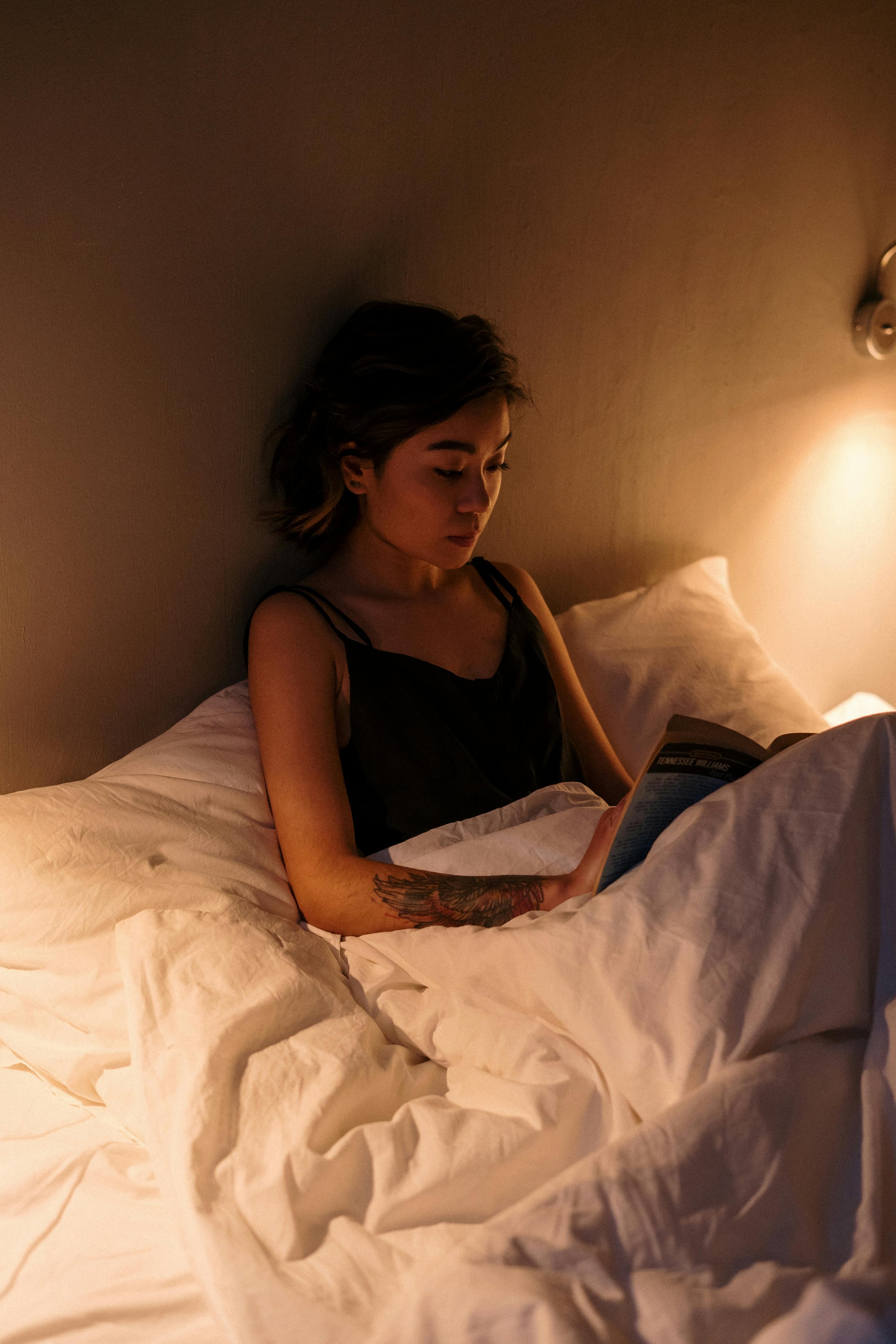
If it’s in the budget, splurge on a luxurious mattress made from hypoallergenic materials like natural latex, memory foam, organic cotton, or organic wool. Make sure you cover that mattress with cozy organic bedding made with organic cotton, linen, or bamboo. Thread counts between 200 and 800 offer prime softness. Once you climb into those cozy sheets, grab a good book and read until you drift to sleep.
Working these changes into your life and staying consistent should help relieve your troubles. But always consult a doctor if your symptoms are consistently interfering with your daily life.
This story’s featured image is by Greg Pappas.